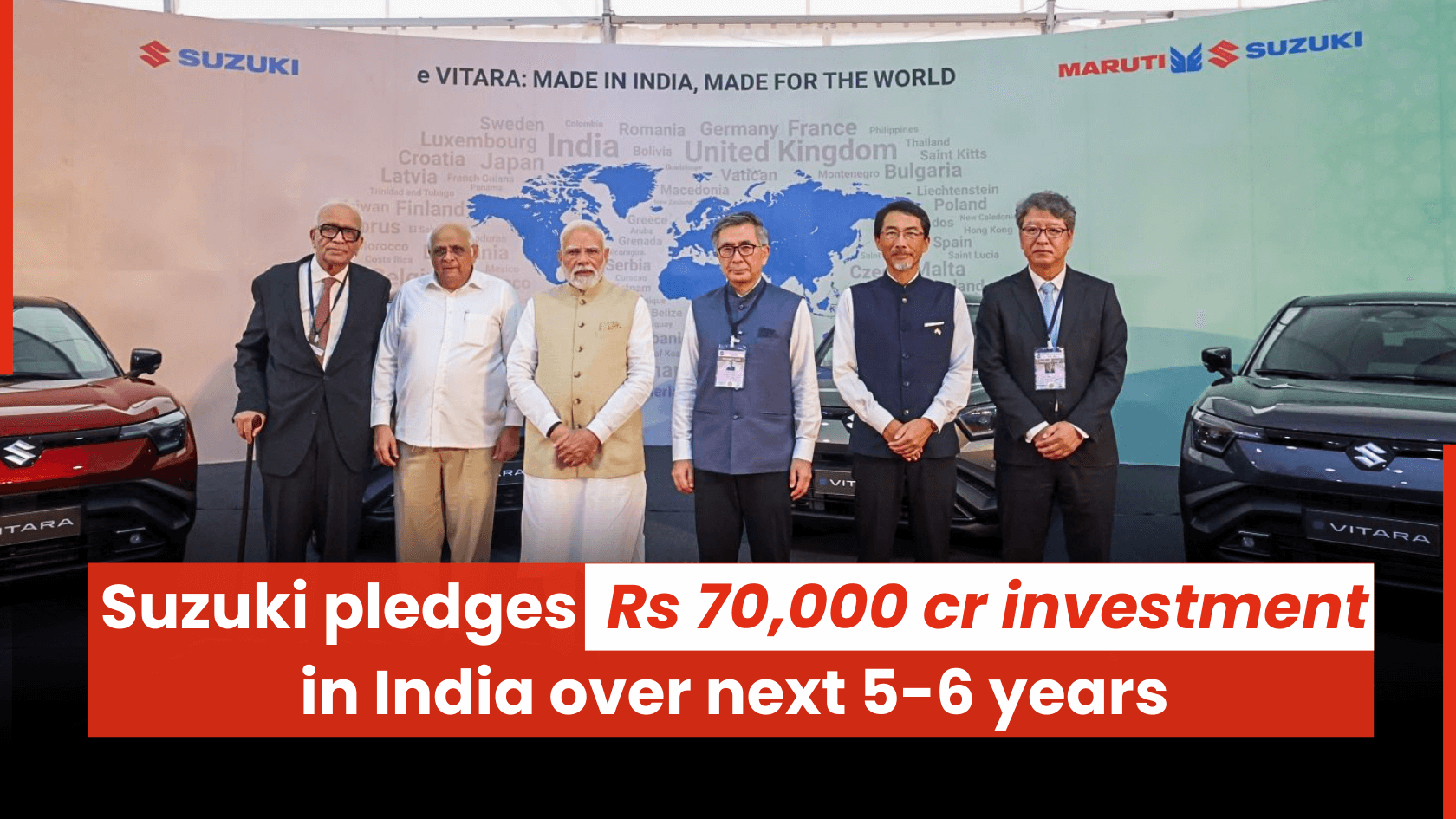
Suzuki Motor Corporation has announced a massive investment of ₹70,000 crore (≈approximately $8 billion) in India over the next 5–6 years to expand its mobility business, encompassing vehicle manufacturing, battery production, R&D, and sustainability.
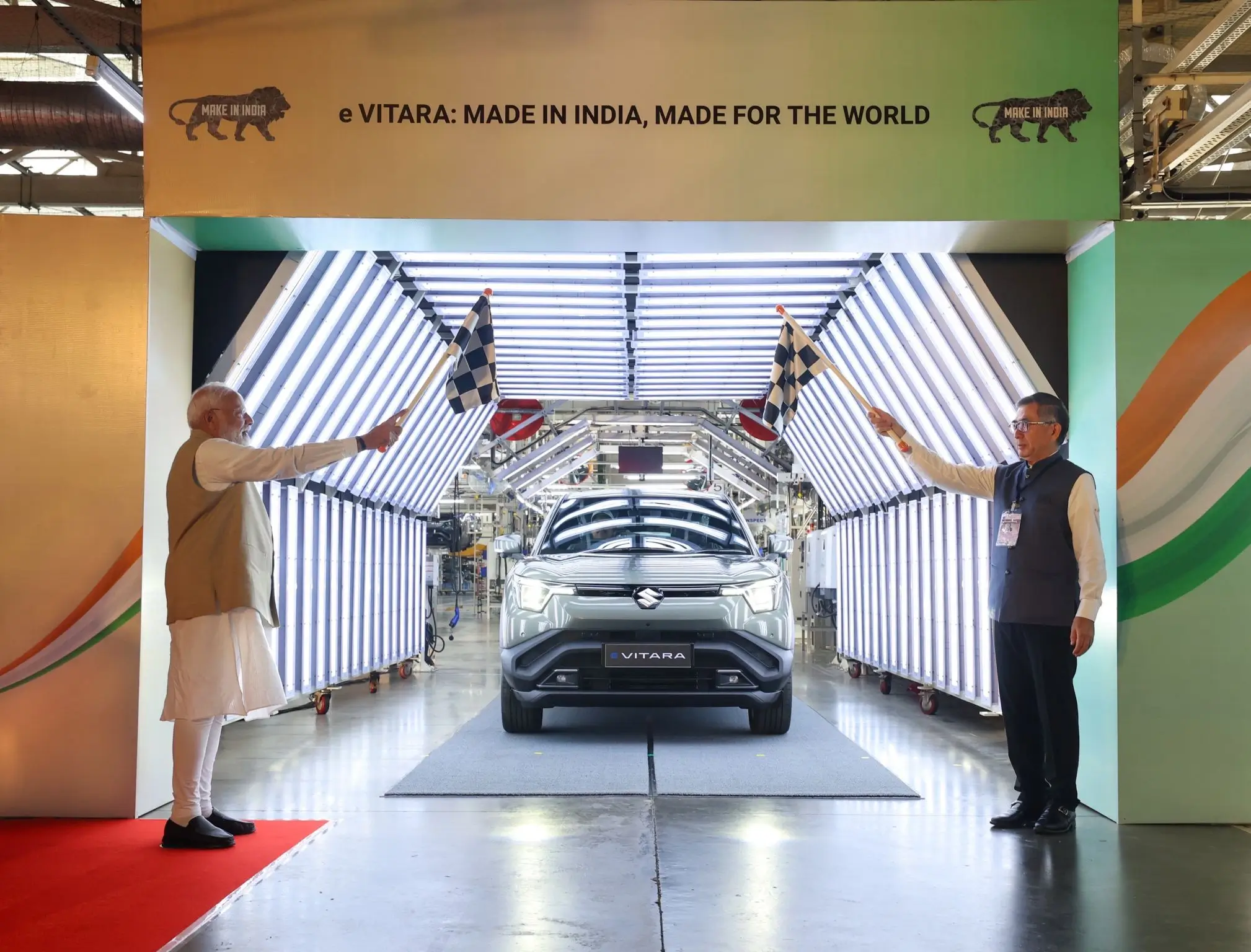
Yesterday in Gujarat, Prime Minister Narendra Modi flagged off Suzuki’s first global electric vehicle, the e-Vitara, from the Hansalpur plant. The event also marked Suzuki Motor Corporation’s announcement of a record ₹70,000 crore investment in India over the next 5–6 years.
Prime Minister Narendra Modi flagged off Suzuki’s first global electric vehicle
Approximately ₹32,000 crore is planned for expanding production capacity, with the Gujarat plant expected to reach an annual production capacity of 1 million cars.
Another ₹23,240 crore will go into developing new models, including four new battery-electric vehicles (BEVs) by 2030. The remaining ₹15,000 crore is set aside for sustainability and technology upgrades, including carbon-neutral initiatives.
Battery manufacturing and localization are also central to the plan, with Suzuki aiming to localize more than 80% of EV battery value.
Alongside EVs, Suzuki will continue investing in hybrids, CNG, and even biogas-powered vehicles to align with India’s clean-energy vision.
Suzuki India – Investment Breakdown
Category
Investment (₹ Crore)
Key Initiatives
Production Capacity
32,000
Expand the Gujarat plant to 1 million units/yr
New Models / R&D
23,240
Develop new vehicles (incl. 4 BEVs by 2030)
Sustainability & Tech
15,000
Carbon-neutral projects, manufacturing upgrades
Battery Localization
Included above
Target ~80% battery value localisation in India
The main projects will be based in Gujarat (Hansalpur/Becharaji plant), with exports planned for over 100 countries. Partnerships include the Toshiba–Denso–Suzuki battery venture in Gujarat and the Suzuki–Toyota–Daihatsu collaboration on EV platforms.
Suzuki India – Project Timeline and Phases
2025: Commercial production of the Maruti Suzuki e-Vitara began at the Gujarat plant, inaugurated by Prime Minister Modi.
2025–26: Around ₹3,200 crore will be invested to add a new EV production line. Maruti plans to produce 67,000 EVs in FY26, initially for export.
2026–2030: Suzuki will launch four new BEV models, expand hybrid and CNG lineups, and localize battery production. By 2030, Maruti aims to double its capacity to 4 million units per year and triple its exports to 7.5 lakh units annually.
Beyond 2030: Suzuki targets 50% market share in India and leadership in EVs, making India its global hub for exports.
Indian Government Collaboration and Policy Support
The investment is closely aligned with Make in India and Atmanirbhar Bharat.
The Gujarat facility was highlighted as a symbol of India–Japan cooperation.
The central government’s EV policy, including Production-Linked Incentive (PLI) schemes, has created a favourable environment for such investments. State-level incentives from Gujarat have also played a role in attracting Maruti Suzuki’s expansions.
Executive and Official Statements
Suzuki President Toshihiro Suzuki emphasised that India has become a global production hub for Suzuki, with Made-in-India EVs set to reach 100+ countries. He called this investment a step toward supporting India’s vision of sustainable green mobility.
Prime Minister Modi described the project as a “new chapter” in Make in India and highlighted its importance for jobs, technology, and exports. Maruti Chairman R.C. Bhargava added that EV adoption will remain gradual in India until battery costs reduce and incomes rise.
Economic Impact and India’s Manufacturing Boost
Suzuki’s infusion of ₹70,000 crore will significantly boost domestic manufacturing. By 2030, Maruti Suzuki is expected to reach 4 million annual production capacity, directly creating thousands of jobs.
Local battery and electrode production will strengthen India’s EV supply chain and reduce import dependency.
The focus on exports to 100 countries will enhance India’s position as a global auto exporter.
Industry and Public Reactions
Maruti Suzuki’s stock touched record highs after the announcement, reflecting investor confidence.
Business media called it the company’s “largest-ever commitment” in India, while analysts pointed out that this investment positions India as a global EV manufacturing base. Public response has been positive, with pride over India-made EVs being exported to developed markets like Japan and Europe.
Sources:Economic Times, Business Today, Financial Express, Hindustan Times, Reuters
Maruti Suzuki India Limited Posted on Linkedin “Hon’ble Prime Minister Shri Narendra Modi today commemorated two historic firsts: Start of Production of Maruti Suzuki’s first Battery Electric Vehicle, e VITARA, for sales in over 100 countries at Suzuki Motor Gujarat Private Limited, a wholly owned subsidiary of #MarutiSuzuki and Suzuki’s first Lithium-ion battery cell & electrode manufacturing in India for strong hybrid electric vehicle at TDS Lithium-Ion Battery Gujarat Private Limited, Maruti Suzuki’s fellow subsidiary.
These milestones mark a significant step forward in Suzuki’s commitment to the Government of India’s ‘Make in India’ and ‘Aatmanirbhar Bharat’ initiatives.
The event was graced by Hon’ble Chief Minister of Gujarat Shri Bhupendra Patel and Ambassador of Japan to India, H.E. Mr. Keiichi Ono.
Maruti Suzuki’s e VITARA is slated to be the largest mass-produced and exported electric vehicle from India. The e VITARA combines Suzuki’s technology with India’s manufacturing prowess, in true spirit of Make in India; Make for the World. The e VITARA is built on a freshly designed EV-only platform and is not an IC engine vehicle converted to EV as the latter involves several design compromises.
TDS Lithium-ion Battery Gujarat Private Limited has become the first company in India to achieve electrode level localization of lithium-ion battery cells, making India self-reliant in battery manufacturing for hybrid electric vehicles. This electrode level localization is one step towards increasing proliferation of Hybrid Electric Vehicles in the country. These lithium-ion batteries go into the hybrid system of the popular SUV model, the Grand Vitara.”
FAQs
What is Suzuki’s ₹70,000 crore investment plan in India?
Suzuki Motor Corporation has announced a ₹70,000 crore investment in India over the next 5–6 years. The plan includes expanding production capacity, developing new electric vehicles, localizing battery manufacturing, and making India a global hub for auto exports.
How will Suzuki’s ₹70,000 crore investment impact India’s auto industry?
The investment is expected to double Maruti Suzuki’s production capacity to 4 million units annually by 2030, create thousands of jobs, strengthen local EV supply chains, and significantly increase India’s car exports to more than 100 countries.
Which models will Suzuki launch under this investment plan?
Suzuki plans to launch four new battery-electric vehicles (BEVs) by 2030, starting with the e-Vitara, which was flagged off in Gujarat in 2025. Alongside EVs, the company will also continue investing in hybrids, CNG, and biogas-powered vehicles.a
Why is Gujarat important in Suzuki’s investment strategy?
Gujarat is the central hub of Suzuki’s India expansion. The Hansalpur plant will produce the e-Vitara and future EV models, while also housing battery manufacturing projects. The state’s investor-friendly policies and infrastructure make it a strategic location for Suzuki.
How many jobs will Suzuki’s ₹70,000 crore investment create in India?
The investment is expected to generate thousands of direct jobs at Maruti Suzuki plants and many more indirect jobs across the supply chain, including auto parts manufacturing, logistics, and EV infrastructure.