The Government of India has announced a major restructuring of the Goods and Services Tax (GST), effective 22nd September 2025.
This landmark decision simplifies the previous multi-slab structure into three clear categories:
5% GST – for essential goods and services
18% GST – the standard rate for most items, including automobiles and parts
40% GST – for super luxury goods such as high-end vehicles, premium imports, and luxury motorcycles
This change is expected to impact the automobile and electric vehicle (EV) sectors significantly.
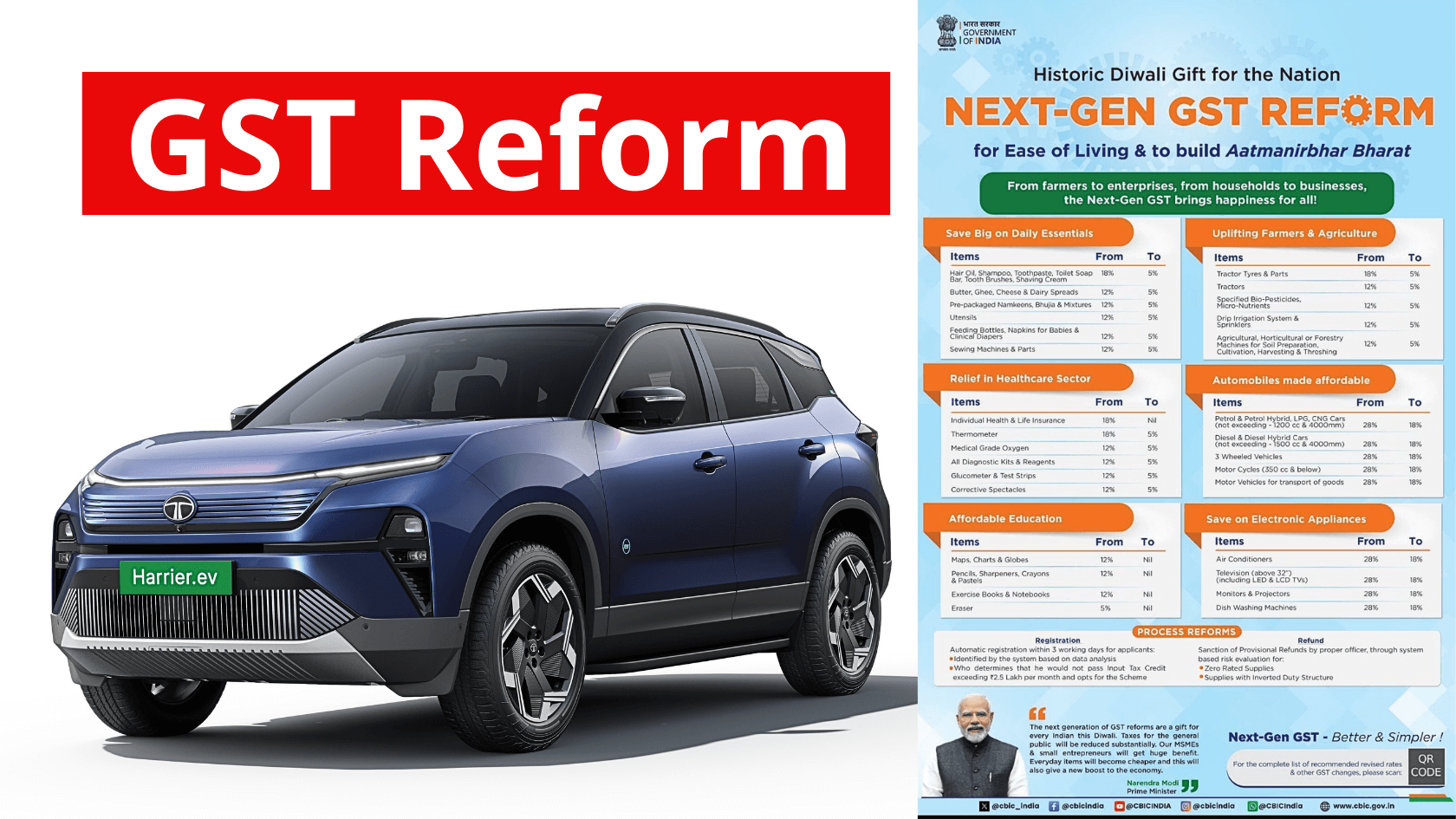
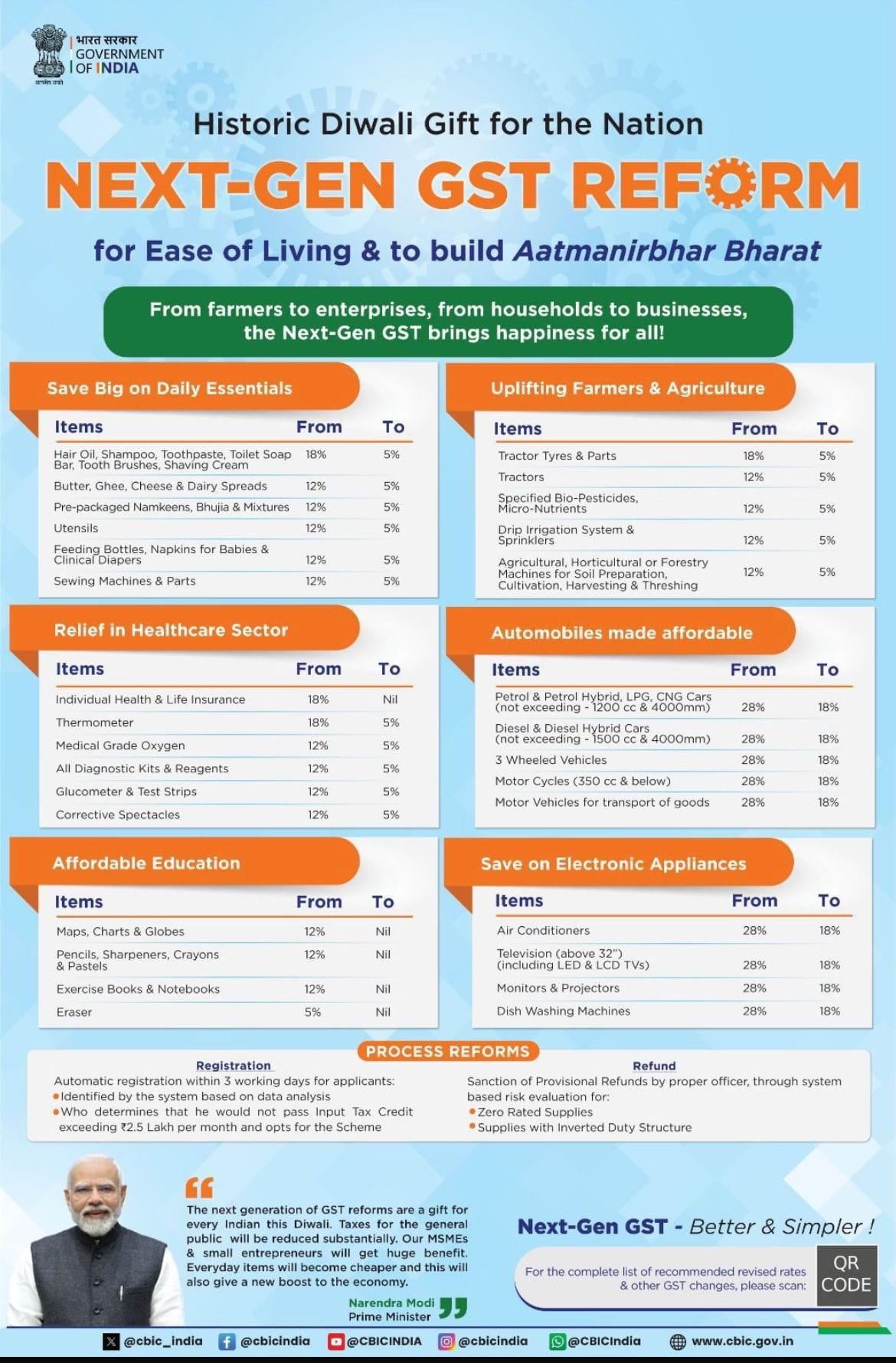
NEXT GEN GST REFORM
Impact on the Auto Industry
Relief for Small Vehicles
Small cars with petrol engines up to 1,200 cc (≤ 4 metres in length), diesel cars up to 1,500 cc (≤ 4 metres), motorcycles up to 350 cc, three-wheelers, ambulances, and light commercial vehicles will now attract 18% GST.
Previously, these segments were taxed at 28% plus cess.
This reduction will make entry-level vehicles more affordable, particularly important ahead of the festive season.
Standardisation for Auto Components
All auto parts and accessories are now uniformly taxed at 18%, replacing earlier variations.
This is expected to simplify compliance and reduce costs for manufacturers and suppliers.
Higher Tax on Luxury and Premium Vehicles
Larger vehicles, cars longer than 4 metres, SUVs, motorcycles above 350 cc, and other premium models are now placed under the 40% GST slab.
While this is slightly lower than the earlier combined rate of GST plus cess, it maintains a high taxation environment for luxury consumption.
On-road prices of many premium vehicles may rise, putting pressure on demand in this segment.
Impact on the EV Industry
5% GST Retained
Electric vehicles will continue to enjoy the 5% concessional GST rate across all categories.
This is a major win for the EV industry, ensuring affordability and supporting India’s clean mobility mission.
Balancing ICE and EV Competitiveness
While EVs remain at 5% GST, the reduction in tax on small petrol and diesel cars to 18% could make conventional vehicles more attractive in the short term.
The industry will closely watch consumer behaviour during the upcoming festive season to see if this shift affects EV adoption.
Vehicle Type / Segment
Previous Tax (GST + Cess)
New Tax (from Sept 22, 2025)
Impact
Small ICE cars (≤1,200 cc, ≤ 4 m)
28% + 1–3% cess ≈ 29–31%
18% GST
Lower tax → more affordable
Small motorcycles (≤350 cc), three-wheelers, ambulances, and auto parts
28% + cess
18% GST
Simplified and reduced tax
Large cars/SUVs/mid-size cars
28% + 17–22% cess ≈ 45–50%
40% GST (no cess)
Slight net relief or steady—premium pricing
Electric Vehicles (all segments)
5% GST
5% GST (no cess)
Retained low tax → adoption bolstered
Key Takeaways
Affordable mobility: Small ICE vehicles and two-wheelers become cheaper.
Simplified compliance: Auto parts and services aligned to 18% GST.
Luxury hit: Super luxury cars and bikes face higher taxes of up to 40%.
EV push intact: All electric vehicles remain at 5% GST, reinforcing the government’s green mobility agenda.
Ravi G. Bhatia (President & Director – JATO Dynamics India) Wrote;
GST 2.0: Small Cars Win, Luxury Faces the Heat, EVs Stay Protected
The GST Council’s September 2025 verdict is nothing short of a reset for India’s tax landscape. By collapsing multiple slabs into three — 5%, 18%, and 40% — the Council has delivered both clarity and a powerful policy signal.
For the auto sector, the changes are immediate and segmented: small cars and mass mobility benefit, luxury vehicles face sharper taxation, and EVs continue to enjoy the strongest incentive. The outcome reflects a balance between consumer affordability, fiscal discipline, and green mobility goals.
The Verdict: Mass Mobility Wins
GST reduced from 28% → 18% on:
Small petrol cars (≤1200cc, ≤4m)
Small diesel cars (≤1500cc, ≤4m)
Motorcycles ≤350cc
Three-wheelers and ambulances
Auto components and accessories
At the same time:
Large cars, SUVs, premium motorcycles → shifted to 40% GST (no cess).
EVs continue with 5% GST across all categories.
The Economic Trade-Off
Savings of ₹10,000–50,000 per vehicle are expected in the mass ICE segment.
Price parity improves between small ICE cars and compact EVs, potentially shifting consumer preference.
Luxury and premium buyers face 10–12% higher on-road prices, impacting demand elasticity.
Policy Signals: Segmented Pragmatism
Affordability First – Mass consumers benefit from lower rates.
Compliance Simplified – Auto parts at a uniform 18% ease supply chain.
Industry Impact
Maruti Suzuki, Hyundai, and Tata Motors gain from small car and compact EV affordability.
Toyota, Honda, and premium OEMs face challenges with higher-taxed hybrids and large cars.
Luxury OEMs (BMW, Mercedes, Audi, Tesla) must reassess pricing and portfolio strategy.
Suppliers benefit from a single 18% GST rate on components.
Conclusion
The new GST structure is a game-changer for India’s auto and EV industry.
By cutting rates for small vehicles and retaining incentives for EVs, the government aims to strike a balance between affordability, industry growth, and sustainability.
However, luxury automakers will face challenges, while mass-market players and EV manufacturers are set to benefit from improved demand and simplified taxation.