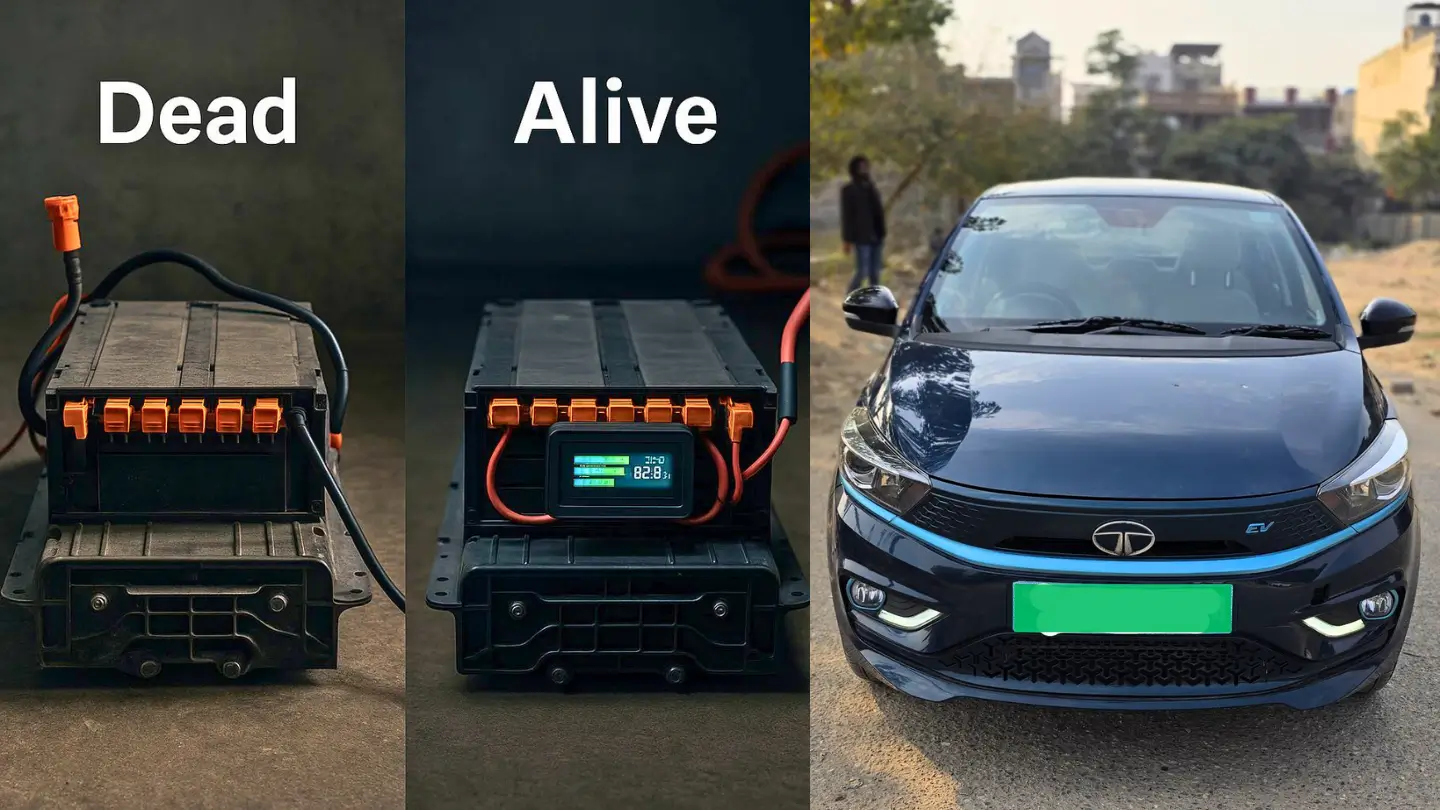
As electric vehicles (EVs) gain traction across India, one of the biggest concerns for both fleet operators and private owners is the steep cost of battery replacement. Often, when a battery stops responding or fails to charge, it’s quickly written off as unrepairable.
But a recent real-world example involving a Tata Tigor EV challenges that assumption.
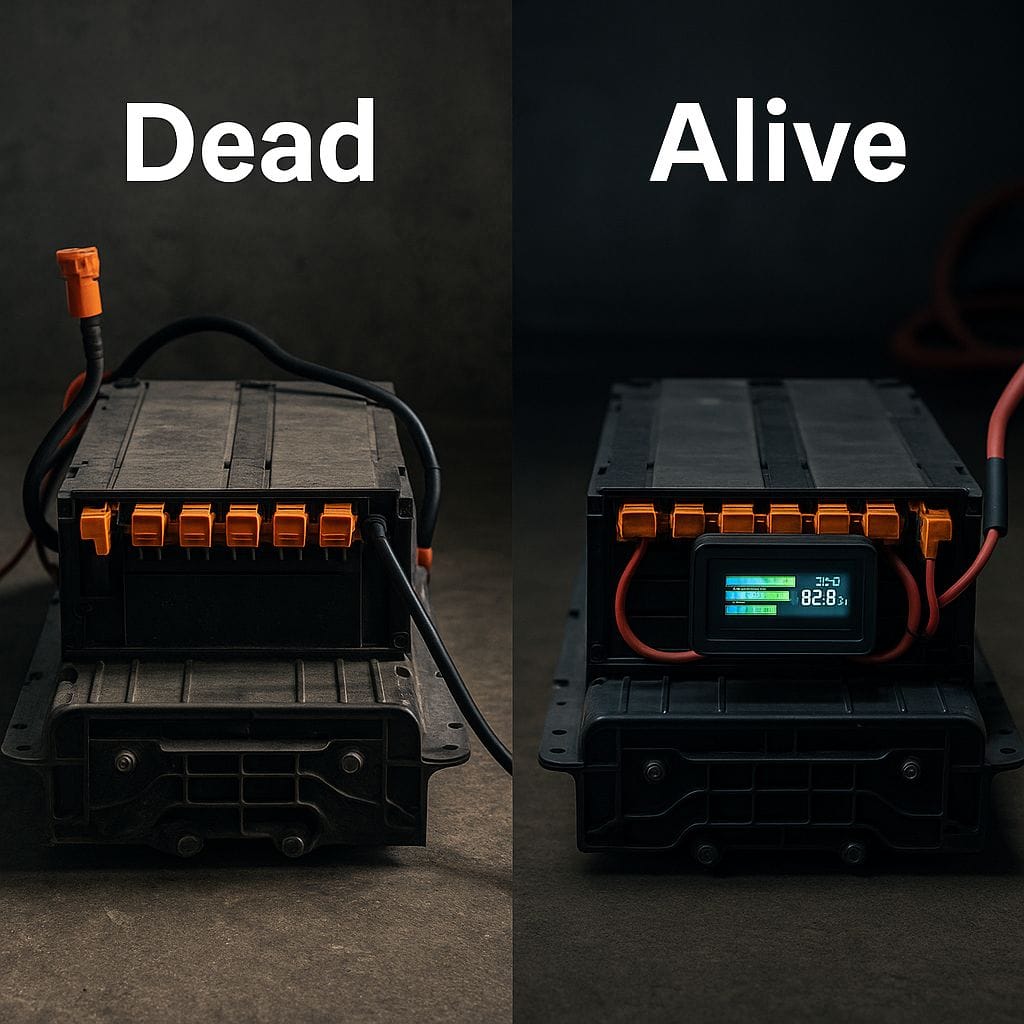
Instead of replacing the entire battery pack, a focused revival process brought it back to life, proving that repair can be both technically feasible and economically sensible.
This article breaks down, step by step, how a high-voltage Lithium Iron Phosphate (LFP) battery—initially declared “dead”—was successfully restored by a homegrown battery diagnostics firm.
The total repair cost? Just ₹55,000, compared to ₹6,00,000 quoted for a full replacement by the original manufacturer.
Join our WhatsApp Community
Understanding EV Battery Failure and Repair in India
Most EV batteries are built to last years, but under certain conditions, such as deep discharge, cell imbalance, or long-term inactivity, they may appear non-functional.
Replacing a traction battery, especially after the warranty period, can cost several lakhs.
For fleet operators managing dozens or hundreds of vehicles, this becomes a significant financial concern.
What this case reveals is that not all battery failures are absolute.
With the right diagnostics and technical approach, batteries that appear unusable can sometimes be repaired and returned to service safely.
Case Study: Tata Tigor EV High-Voltage LFP Battery
A Tata Tigor EV fitted with a 108s high-voltage LFP battery (345.6V nominal) was brought in for assessment after becoming completely immobile.
The chronology of the revival process is outlined below:
Day 0 – Initial Assessment
- The vehicle was towed in due to a complete failure to start.
- The battery’s charging port showed zero volts.
- Initial assumption: the battery was entirely non-functional and needed replacement.
- OEM recommended replacing the entire battery pack at a cost of ₹6,00,000.
Day 1 – Diagnostic Evaluation
- The battery pack was electrically isolated for safety.
- Internal string voltages revealed some remaining charge and activity.
- A severe imbalance was observed between different groups of cells, indicating a possible cause of failure.
Day 2–3 – Controlled Charging
- A controlled 0.1 °C soak charge was applied using a bench power supply.
- The voltage was carefully raised to 76.65V across a 21s cell string.
- No thermal events or abnormal conditions were observed during this process.
Day 4 – Voltage Balancing
- A 15A active balancer was connected to correct voltage discrepancies across cell groups.
- Voltages were brought close to their designated upper cut-off.
- After resting the pack, voltages were re-checked to confirm minimal drift.
Day 5–6 – Capacity Testing
- The battery was discharged at a 0.5C rate to assess usable capacity.
- It delivered 63Ah out of a rated 75Ah, achieving an 84% recovery.
- Total energy output was measured at 22.11 kWh.
Day 7 – Reinstallation and Final Testing
- The battery pack was reconnected with the vehicle’s native Battery Management System (BMS).
- It underwent real-world load testing under traction conditions.
- The battery cleared all performance benchmarks and was certified fit for continued use.
The case study, shared through a detailed LinkedIn post by Mr. Romesh Gupta, Founder and Managing Director of Yanti Innovative Electromotive Solutions Pvt. Ltd..
An emerging company specialising in AI-powered EV battery diagnostics and revival, spanning seven days and highlights the potential of data-driven battery analytics and targeted restoration techniques to significantly reduce both costs and electronic waste.
Outcome Summary
| Parameter |
Value |
| Recovered Capacity |
203Ah (94%) |
| OEM Replacement Cost |
₹6,00,000 |
| Repair Cost |
₹55,000 |
| Total Savings |
₹5,45,000+ |
| Time Required |
7 Days |
Key Technical Highlights
- Revival achieved without replacing the entire battery pack.
- Thermal monitoring ensured safety during controlled charging.
- Active balancing corrected deep cell group imbalances.
- Bench testing simulated real operating conditions to verify performance.
- Compatibility with the original BMS was maintained.
Who Can Benefit from EV Battery Repair?
This case is relevant to multiple stakeholders in India’s EV ecosystem:
- EV Fleet Operators seeking to minimise recurring battery costs
- NBFCs and Financiers managing out-of-warranty EV assets
- OEMs and Dealers handling post-sale battery support
- Used EV Buyers are facing uncertainty about the battery condition
- Private EV Owners whose vehicle batteries are past warranty.
Conclusion
This case shows that just because an EV battery isn’t responding doesn’t mean it’s beyond saving.
With the right diagnostic tools and technical know-how, even badly imbalanced or seemingly dead batteries can be brought back to life.
Let’s Understand How much it costs to replace an electric car battery in India.
As India’s EV market continues to grow, repair and revival solutions like these are likely to play a big role in making electric mobility more affordable, reliable, and sustainable.
The post EV Battery Repair in India: This startup saves ₹5.45 Lakh on Dead Tata Tigor EV Battery appeared first on .