
The limited petroleum fuel availability and increasing global harmful gas emissions have forced us to look for alternative ways of fuels for vehicles.
In meeting fuel demand for vehicles, biofuels, batteries, and hydrogen-based fuels are being researched and are used to drive transportation. In 2023, more than 14 million electric vehicles are expected to be sold out while the hydrogen fuel cell vehicle market is expected to reach US$ 12,324.9 million by 2028.
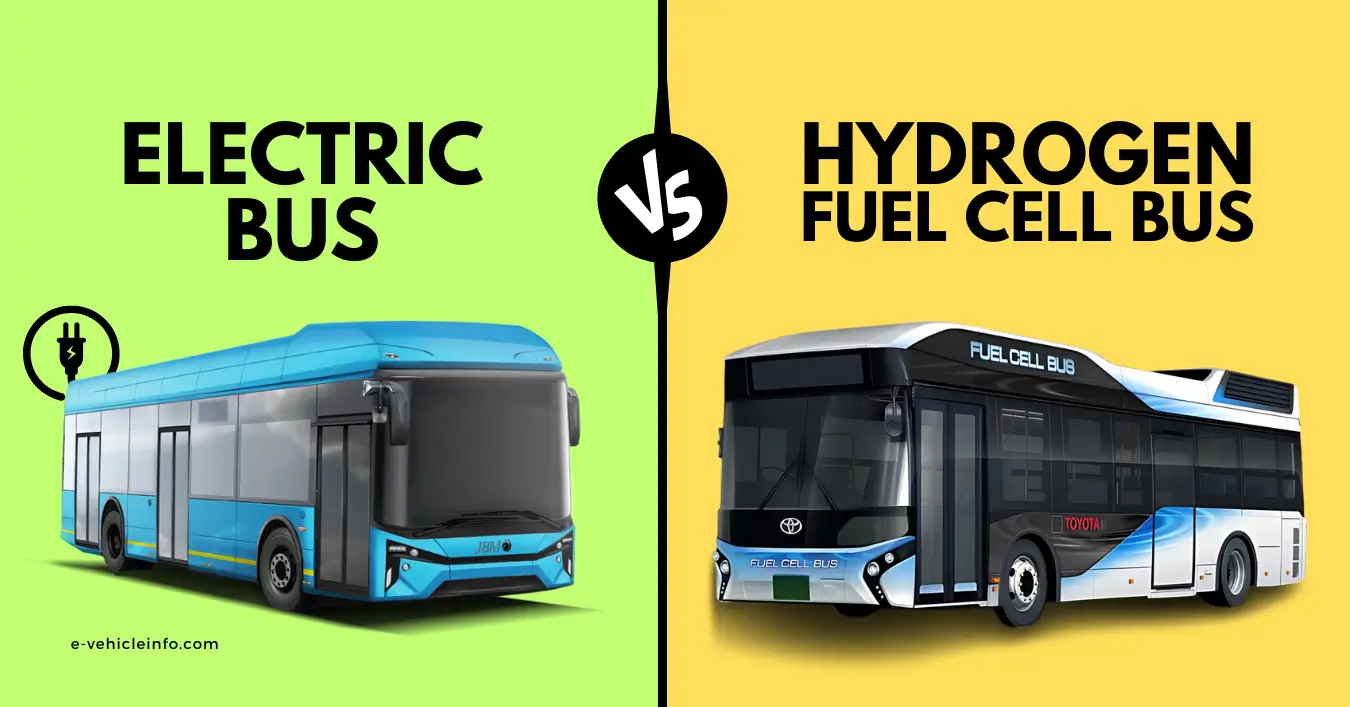
However, the latest Italian study claims that Battery Electric Buses (BEBs) are more energy efficient (for tank to wheel considering) than Fuel Cell Electric Bus (FCEB) by 2-2.45 times. Tank to Wheel means energy consumption and emissions in vehicles from the point where fuel is stored to the point where it is used to propel the vehicle’s wheels.
This Italian study is based on data collected from 21 fuel cell and electric buses operating in The province of South Tyrol, Italy which has 535,000 inhabitants.
Out of 21 buses, 16 buses were Fuel Cell Electric Buses (12 Solaris Urbino 12 Hydrogen and 4 Mercedes O530 Citaro Fuel Cell Hybrid) and 5 were Battery Electric Buses (3 Solaris Urbino 12 Electric and 2 Solaris Urbino 18 Electric).
The data was collected from these 21 buses between January 2021 to April 2022 and the total distance covered by these buses was 537,586 km during this period.
Let’s dive into Electric Bus vs Hydrogen Bus
A brief detail of these buses used for data collecting is available in the table below:
Parameter
Solaris Urbino 12 Hydrogen
Mercedes O530 Citaro Fuel Cell Hybrid
Solaris Urbino 12 Electric
Solaris Urbino 12 Electric
Available buses
12
4
3
2
Seats
Max. 39 + 4
31
Max. 39 + 4
49 + 8
Tank/battery capacity
37 kg H2
35 kg H2
210 kWh
Up to 300 kWh
Range [km]
up to 350
up to 250
up to 300
at least 200
First production year
2019
2009
2013
2014
Energy efficiency [kWh/100 km]
310.24
335.75
137
153.8
Running Cost [€/km]
1.23
1.36
0.53
0.58
The authors have considered the following points in concluding the study
Distance covered by the fleet of these buses: which includes the distance covered by each bus model, the distance covered by type of line (line means urban, suburban), and the distance covered by each bus model concerning the type of line.
Energy efficiency: Tank-to-Wheel (TTW) for each bus model [kg H2/100 km, kWh/100 km] by assuming an Energy heating value of 33.33 kWh per 1 kg H2.
Economic performance: Refuelling and recharge costs [€] and Running costs per km [€/km].
Environmental performance: Reduction of CO2 emissions when replacing conventional buses with these buses [tons CO2 ].
Based on these four considerations, authors have concluded that Battery Electric Buses are 2 to 2.45 times more energy and economically efficient than Fuel Cell Electric Buses. The below table is for more details.
Parameter
Solaris Urbino 12 Hydrogen
Mercedes O530 Citaro Fuel Cell Hybrid
Solaris Urbino 12 Electric
Solaris Urbino 12 Electric
Distance covered by each model [km]
211,173
88,114
150,531
87,768
Distance [%]
39
16
28
16
Fuel Consumed
18,848 kg H2
8706 kg H2
200,198 kWh
127,658 kWh
Energy efficiency [kWh/100 km]
310.24
335.75
137
153.8
Running Cost [€/km]
1.23
1.36
0.53
0.58
CO2 savings: IC engines buses [tons CO2]
230.9
96.3
164.6
95.9
What are Battery Electric Buses and Hydrogen Fuel Cell buses?
Battery Electric Bus is powered by batteries (Li-ion batteries most commonly). The battery installed on the bus is used to propel the motor to drive the wheels. The battery is charged at a charging station or through a pantograph installed at a bus stop.
Electric Bus Advantages
Low operating cost
Zero tailpipe emissions
Quiet Operation
Electric Bus Disadvantages
Long Charging time
High Initial cost
Limited Range
Hydrogen Fuel Cell Electric Bus is powered by electricity generated from Fuel Cell to drive the motor installed on buses like battery electric buses. In a fuel cell, hydrogen from a pressurized tank is released in the presence of oxygen to generate electricity. Water is also produced as a byproduct. You can find advancements in hydrogen technology here
Hydrogen Fuel Cell Bus Advantages
Long Range
Fast Refueling
Zero tailpipe emissions
Hydrogen Fuel Cell Bus Disadvantages
Higher Operating Cost
Lack of Hydrogen Refueling Infrastructure
Maintenance Challenges
Top 5 Battery Electric Bus Companies Worldwide
Volvo Group – Sweden
Hyundai Motor Company – South Korea
BYD- China
Tata Motors- India
Proterra – USA
Top 5 Hydrogen Fuel Cell Bus Companies Worldwide
Safra- France
Solaris Bus & Coach – Poland
Mercedes-Benz – Germany
Foton Motor – China
Rampini – Italy
Final Thoughts
The content of this article is based on the research paper “Monitored data and social perceptions analysis of battery electric and hydrogen-fuelled buses in urban and suburban areas” published in the Journal of Energy Storage in 2023.
Both Battery Electric Bus as well as Fuel Cell Electric bus-based technology are in the developing phase and are a way for green mobility.
At present, production, transportation, and storage of hydrogen are challenging but work is being done to cater to the challenges.
The same is true with battery technology which is being modified each day to reduce charge time and provide safety, and long range. Both technologies are going to dominate in the future to meet the demand for clean transportation.


