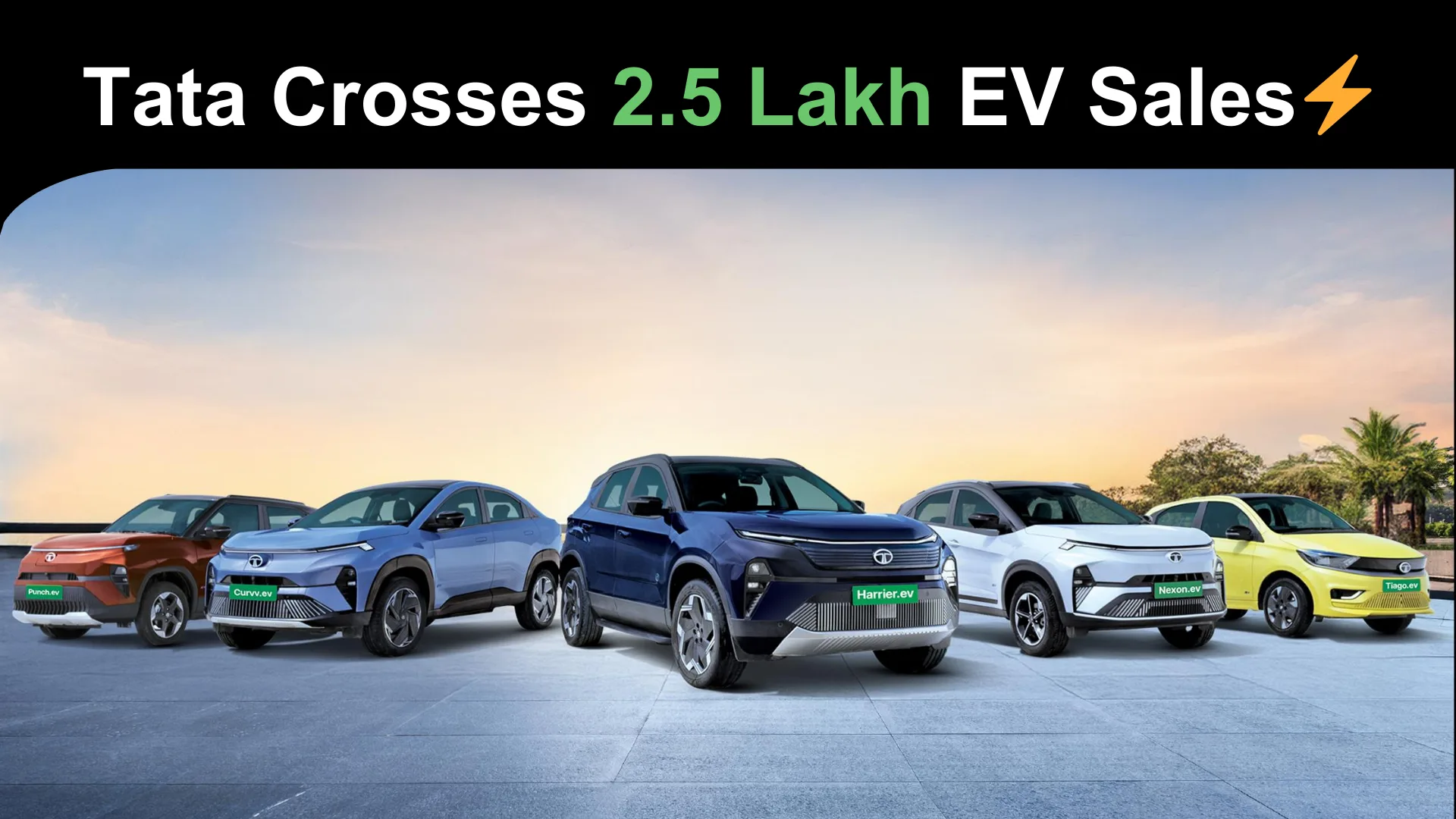
Tata Motors has crossed a major milestone in India’s electric mobility journey, with over 2.5 lakh electric passenger vehicles now on Indian roads, reinforcing the company’s position as the country’s largest and most established EV maker.
The milestone comes as electric vehicles steadily move from early adoption into mainstream use.
Tata Motors currently accounts for around 66% of all electric passenger vehicle sales in India, giving it a commanding lead in a market that is becoming increasingly competitive.
Tata Nexon.ev Emerges as India’s First 1-Lakh-Sales EV
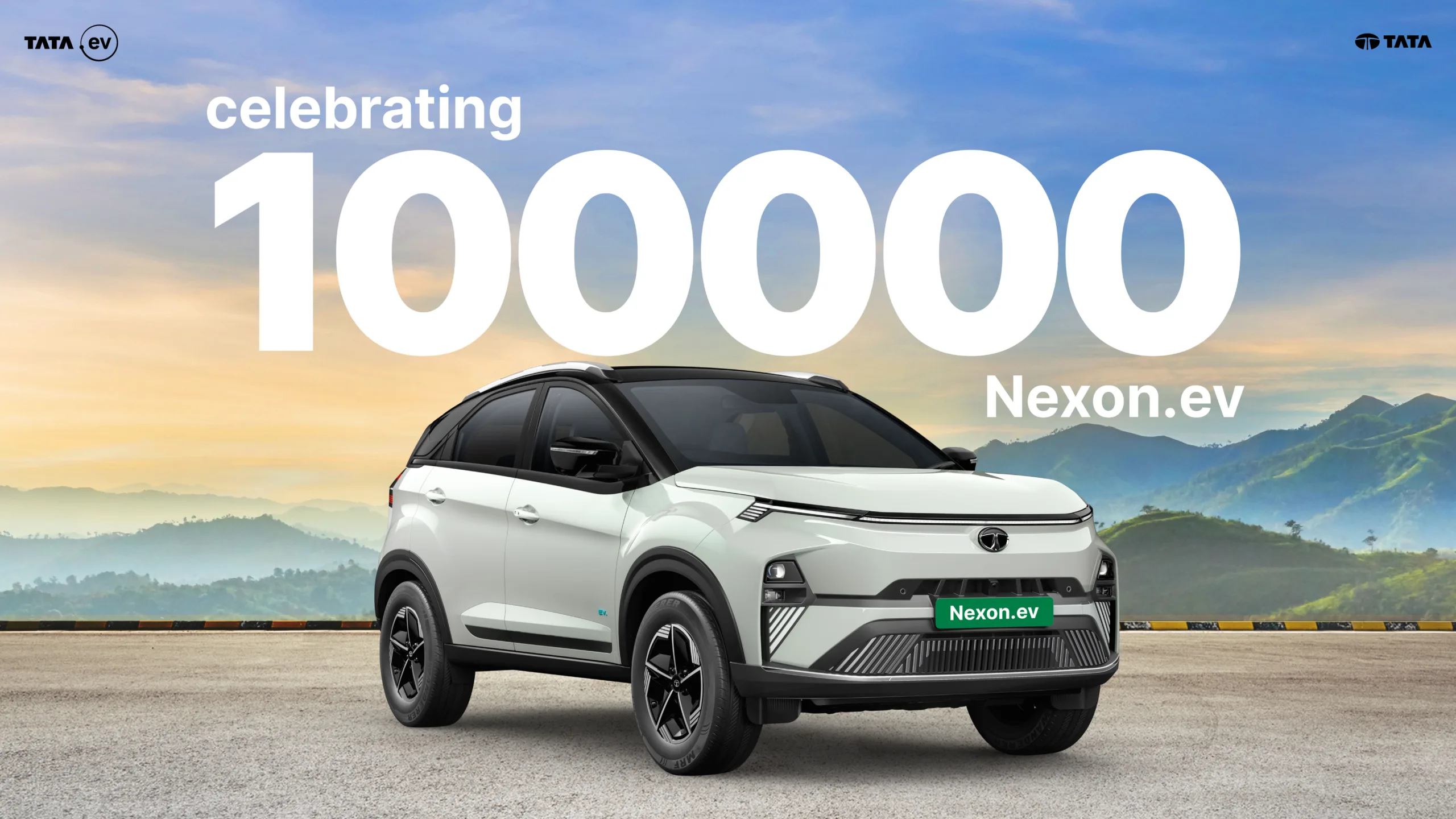
A key contributor to this milestone has been the Nexon.ev, which has become the first electric car in India to cross 1 lakh cumulative sales.
Since its launch in 2020, the Nexon.ev has played a central role in shaping India’s EV adoption curve, helping normalise electric cars for everyday use.
Tata’s current EV portfolio spans multiple segments and price points, including Tiago.ev, Punch.ev, Nexon.ev, Curvv.ev and Harrier.ev, along with the XPRES-T EV for fleet operators. This wide lineup has allowed the company to capture both private and commercial demand.
EV Usage Moves Beyond Metros
Data shared by Tata Motors suggests that EV adoption is no longer limited to large cities. Tata EV owners are spread across more than 1,000 towns and cities, indicating deeper penetration into Tier-2 and Tier-3 markets.
The company also notes that 84% of Tata EV customers use their vehicle as their primary car, challenging the perception of EVs as secondary or city-only vehicles. Over 26% of buyers are first-time car owners, highlighting EVs as an entry point into car ownership for a new segment of consumers.
High Real-World Usage and Long-Distance Confidence
Tata Motors says its EVs are seeing high real-world usage, with owners driving an average of around 20,000 km annually.
Notably, about 26,000 customers have already crossed 1 lakh kilometres of usage, and nearly half of all Tata EV owners have undertaken at least one long-distance trip exceeding 500 km.
According to the company, Tata EVs have now travelled through every major Indian state and national highway, collectively covering an estimated 12 billion kilometres, resulting in savings of around 1.7 million tonnes of CO₂ and nearly 800 million litres of fuel.
Charging and Service Ecosystem at Scale
Supporting this growth is what Tata Motors describes as India’s largest EV charging ecosystem.
The company says it now has access to over two lakh charging points, including home, community and public chargers through partner networks. Its public charging aggregator covers more than 20,000 charging points, while 100 MegaCharging Hubs with high-speed chargers have been deployed along key corridors.
On the service side, Tata has built a nationwide EV support network with around 1,500 dedicated EV service bays and over 5,000 trained EV technicians, aimed at addressing one of the key concerns around EV ownership.
Tata’s Push for Localisation
Tata Motors has also accelerated localisation across its EV value chain.
The company says its electric vehicles now feature over 50% locally manufactured content, including battery packs, battery management systems, power electronics and thermal systems, developed in collaboration with Tata Group companies and domestic suppliers.
Plans include sourcing locally produced high-voltage battery cells from Agratas’ upcoming gigafactory in Sanand, as part of a broader push to reduce import dependence and strengthen supply security.
What’s Next: New EV Launches and Scale-Up
Looking ahead, Tata Motors plans an aggressive expansion of its EV lineup:
-
CY26: Launch of Sierra.ev and a new Punch.ev
-
End of CY26: Introduction of the Avinya range of premium EVs
-
By FY30: Five new EV nameplates, along with multiple updates and refreshes
The company also plans to scale charging infrastructure to 4 lakh charge points by CY27, including over 30,000 public fast chargers, and reach one million charge points by 2030 through its open collaboration framework.
Industry Context
As India targets rapid electrification of personal mobility, Tata Motors’ scale, early investments and ecosystem-led approach have positioned it as a key driver of the transition.
With rising competition from global and domestic players, the next phase will test how effectively the company can maintain leadership while expanding into new segments and premium EV offerings.
For now, the 2.5-lakh sales milestone underscores how electric vehicles are becoming an increasingly normal part of Indian roads no longer limited to early adopters or urban niches.